Dynamic vs. Static QR Codes: The Honest 2026 Comparison

The question gets asked every week: "Should I generate a static QR code or pay for a dynamic one?" Most of the answers online are written by companies that sell dynamic QR subscriptions, so the verdict is predictable. This piece is different. We run a free in-browser generator at QRSansar, and we also run a dynamic QR dashboard. We have no incentive to push you one way or the other.
Here is the honest 2026 comparison, based on how the technology actually works, what each option costs over a product's lifetime, and the surprisingly common situations where the "primitive" static QR is the smarter business decision.
What is actually encoded in the QR code
This is the part that confuses most marketers. A QR code is just a 2D barcode that encodes a string of characters. That string can be anything: a URL, a phone number, a Wi-Fi credential, or 3 KB of plain text. The "static" vs "dynamic" distinction has nothing to do with the code itself. It is entirely about what URL you choose to encode.
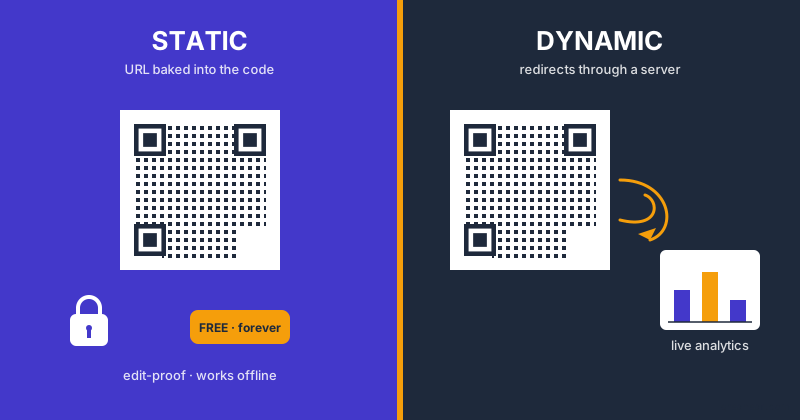
- Static QR code: encodes the final destination URL directly. Scan it, and the phone opens
https://yourcompany.com/menuimmediately. There is no middleman. - Dynamic QR code: encodes a short redirect URL owned by a QR service, like
https://qrs.link/abc123. The phone hits that short URL, the service logs the scan, and then issues an HTTP 301 or 302 redirect to whatever destination you have currently configured in your dashboard.
That single architectural difference is responsible for every other trade-off in this article. Once the redirect layer exists, you can edit the destination, run analytics, A/B test, and apply geo or time rules. Once it doesn't, you can't do any of that, but you also have no recurring costs, no dependencies, and no risk of a third party going out of business and bricking your printed material.
A static QR code is a permanent piece of typography. A dynamic QR code is a subscription to a service that happens to be addressable via a QR code.
For the underlying symbol specification (versions, modules, masking, error correction), both types follow ISO/IEC 18004 identically. You can read the Wikipedia overview of QR code types for a refresher on the symbology itself.
Side-by-side comparison
| Dimension | Static QR | Dynamic QR |
|---|---|---|
| Cost | Free forever | Subscription, typically USD 5 to 50 per month |
| Editable after print | No | Yes |
| Scan analytics | None (unless your destination tracks UTMs) | Built-in (scans, location, device, time) |
| Privacy for scanner | Higher — direct to destination | Lower — service sees every scan |
| Works offline (Wi-Fi, vCard, payment QRs) | Yes | No, redirects require internet |
| Dependency risk | Zero | Service must stay alive |
| URL length encoded | Whole destination URL | Short redirect URL only |
| QR density | Higher (longer URL) | Lower (short URL) |
| A/B testing | No | Yes |
| Geo or time targeting | No | Yes (on most platforms) |
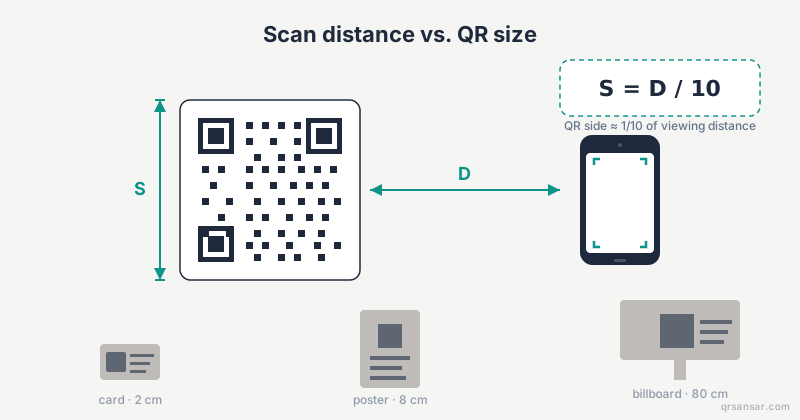
The density point matters more than people think. A static QR encoding https://yourcompany.com/products/spring-2026-launch?utm_source=poster&utm_campaign=spring will be visibly denser than a dynamic QR encoding https://qrs.link/sp26. On a small business card, that density difference is the gap between "scans first time" and "user gives up after three tries."
When static is the right call
Marketing blogs love to tell you static is dead. It isn't. Here are concrete situations where static beats dynamic, every time.
One-time or single-event use
Wedding RSVP page. Conference Wi-Fi QR. Receipt for a one-day pop-up shop. The destination will never change because the event ends and the QR becomes meaningless. Paying a monthly subscription for something with a fixed lifespan is just throwing money away.
Maximum-privacy or offline contexts
Wi-Fi QR codes encode the SSID and password directly into the symbol. There is no redirect, no internet round-trip, and no third party that can ever see your network credentials. The same goes for vCard QR codes, EPC payment QRs, and Nepal's Fonepay/eSewa national QR. These are all designed to work offline and to keep the data inside the printed symbol. Wrapping any of them in a dynamic redirect would defeat their purpose and create a single point of failure.
If you are generating these, use a static generator like the one on /wifi, /vcard, /epc, or /nepalqr. Each of them encodes the full payload directly into the QR symbol — your data never touches our servers.
You own the destination domain and it isn't going anywhere
If you encode https://yourcompany.com/promo and you also own yourcompany.com, you can change what /promo returns on your own web server at any time. You get the editability of a dynamic QR without the subscription, because the redirect logic lives on infrastructure you already operate.
This is the trick that experienced marketing teams use. They generate a static QR pointing at a clean URL on their own domain, and they treat that URL as a permanent identifier. They use /url to make the QR, point it at yourcompany.com/spring, and then control the routing in their CMS.
You want to avoid third-party shorteners
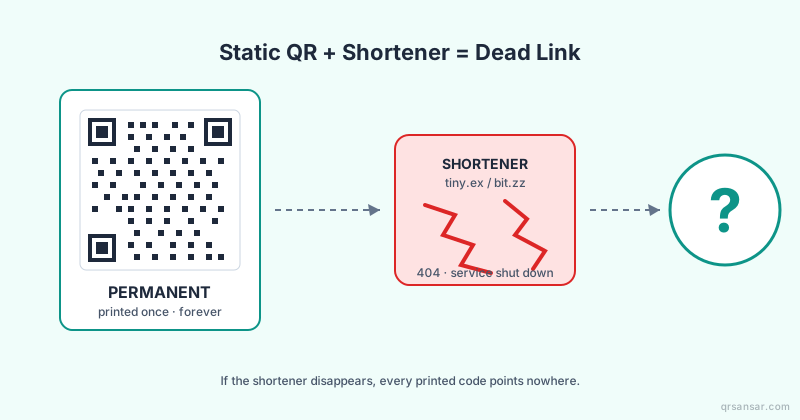
This is the elephant in the room. We have written a full piece on why you should never use a third-party shortener inside a static QR, but the short version: every time the shortener dies, your printed material becomes a dead link. Goo.gl, bit.ly free tier limits, X.co — graveyards. If you must use static, encode a URL on a domain you control.
When dynamic is essential
Dynamic earns its subscription fee in four scenarios.
- Multi-campaign reuse of the same physical surface. A storefront window decal that has to point to different promotions every month. Reprinting decals quarterly costs more than the subscription.
- Print runs over a few thousand units. If you print 10,000 flyers with a typo in the URL, dynamic lets you fix the redirect. Static forces a reprint.
- A/B testing creative or landing pages. Dynamic platforms can split traffic between two destinations. Static cannot.
- B2B sales collateral that lives for years. Conference banners, demo equipment QR labels, hardware service tags. The product evolves but the printed asset stays. Dynamic redirect lets the QR follow the product.
The fourth one is where dynamic really shines. Industrial equipment with a QR sticker pointing at a service manual will outlive at least three website redesigns. A static QR encoding the URL of a 2026 manual page will be a 404 by 2030. A dynamic QR redirects to whatever the current manual URL is.
The real ROI math
Let's run a concrete example. You print 10,000 trifold flyers at USD 0.18 each. Total print cost: USD 1,800. Three weeks after distribution, marketing realises the landing page slug changed from /spring-promo to /spring-2026 because product renamed the campaign.
With a static QR, the 10,000 flyers become useless. You either reprint (USD 1,800 plus design time) or you set up a permanent redirect on your own server, which only works if you anticipated this and encoded a URL on your own domain.
With a dynamic QR at USD 15/month, you log in, change the destination, and the next scan goes to the right place. Annual cost: USD 180. You save USD 1,620 on this single incident.
Now run the inverse. You print 200 business cards with a static vCard QR pointing at the holder's own contact data. The QR is offline-only, never changes, and lasts the life of the card. A dynamic vCard subscription at USD 10/month per employee for a 50-person company is USD 6,000 a year for a problem that does not exist.
The decision is not "which type is better" — it is "does this specific QR code have a non-trivial chance of needing to change after it is printed?" If yes, dynamic. If no, static.
EMVCo, payment QRs, and the static-only category
If you are working with merchant payment QRs — EMVCo's specification for QR-code-presented merchant payments — you are in static territory whether you like it or not. The EMVCo specifications define the exact payload format that a payment QR must contain: merchant ID, currency, optional amount, CRC checksum, and so on. Wrapping that payload in a redirect would break the payment standard. Fonepay, UPI, PIX, EPC SEPA, and the various national merchant schemes all follow this pattern. There is no dynamic option, and there shouldn't be.
Scan analytics: the other side of the trade
Dynamic vendors sell heavily on analytics. They are not wrong — scan counts, geo, device, and time data are genuinely useful for campaign measurement. But there are two caveats most people don't hear.
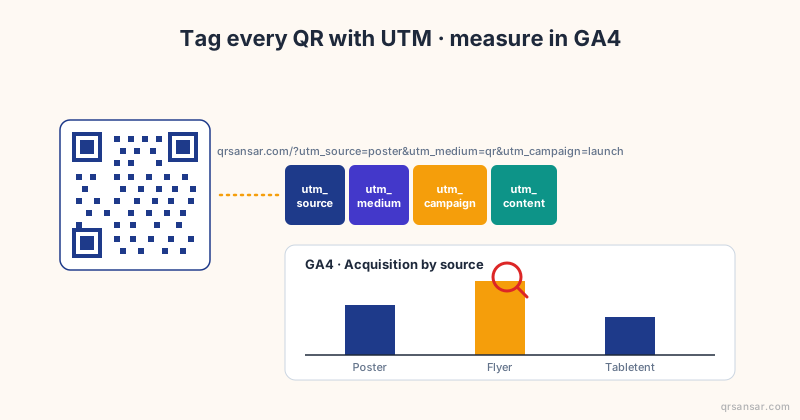
First, you can get most of this from a static QR if your destination URL has UTM parameters and you have Google Analytics 4 properly configured. Static can answer "how many people scanned and visited" — it just can't answer "how many people scanned and bounced before the page loaded." For most campaigns, that gap is acceptable.
Second, dynamic analytics belong to the vendor. If you switch providers, the historical scan data does not migrate. That is a real lock-in cost that nobody mentions in the sales pitch.
For print-friendly QR codes that Google can actually crawl and validate, see Google Search Central's notes on QR codes in print materials — the general guidance is short, scannable URLs and clear destinations.
A decision tree
Use this in the next 30 seconds and you will know which type to generate.
- Will the printed asset live longer than 6 months? If no → static.
- Is the QR offline-by-design (Wi-Fi, vCard, payment)? If yes → static, no exceptions.
- Will the destination URL likely change before the asset is retired? If yes → dynamic.
- Do you own the destination domain and have a CMS or redirect layer there? If yes → static is fine, point at your own URL.
- Do you need scan-level analytics, A/B testing, or geo rules? If yes → dynamic.
- Are you printing more than 5,000 units? Lean dynamic just for the insurance.
Generate your QR with the right tool
If you have made the call and want a free, in-browser static QR code, head to our URL QR generator at /url. The data never leaves your device — we don't even have servers that see your URL.
If you need editable links with analytics, our dynamic QR dashboard at /dash gives you redirect management, scan stats, and the ability to change destinations after print. No long-term contract, and you can downgrade to static whenever the campaign ends.
Whichever you choose, the most important rule is this: pick deliberately. The default of "I'll just use whichever generator comes up first on Google" is how marketing teams end up with USD 1,800 of dead flyers or USD 6,000 of unnecessary subscriptions. Five minutes of thinking now saves both.